It Took Me Three Years to Understand Industry Databases. Grandma Explained Them by Wrapping a Single Zongzi.
Article images may contain Chinese text.



Staring at the glaring red on her screen, Lin Wei suddenly caught the fresh scent of zongzi leaves.
It came from the zongzi Zhang, her colleague at the next desk, had left for her. His family had sent some from his hometown, and before leaving work he had insisted she take one: "It's the Dragon Boat Festival. Don't live on takeout."
She had saved it, setting it beside her keyboard. It was still warm, but she had already forgotten she was hungry.

"Missing again."
She sighed. This was the third time this week: the collection side showed a pharmaceutical distributor's distribution data as "normal," yet three days' worth of volume was missing from the report. The sales director had @mentioned her in the group chat. His wording was polite, but she could read the anxiety behind it:
"This quarter's channel analysis meeting has been moved up to tomorrow afternoon. Will the data be ready on time?"
Would it?
She traced the issue through the process and finally found a cause so simple it was maddening: the distributor had renewed its business license three months earlier, changing both its full company name and its Unified Social Credit Code. But her company's industry master database was still the version from three years ago. It had no record of the change at all—the system did not recognize the company and simply discarded its data.
More frustrating still, this was not an isolated problem. The same customer appeared under three names in snapshots of the industry database from different years: its registered business name, a former name, and an abbreviated name. Because those names did not match, the data kept "wandering." Large sections of key fields were blank because the outdated industry database template had never included the fields required by the new rules. As for why the transmission pipeline was a black box, the integration standards were still the version from five years ago and no longer matched current interface protocols.
It was like a poorly wrapped zongzi: as it boiled, rice leaked through the gaps, clouding the entire pot.
She suddenly remembered watching her grandmother wrap zongzi when she was little.
Back then, they lived in the countryside. Every year before the Dragon Boat Festival, Grandma would take a small stool out into the courtyard and sit down.
Lin Wei thought wrapping zongzi was easy: take a leaf, add a handful of rice and a piece of meat, and tie it up. Then, at seven, she insisted on trying it herself.
Grandma did not stop her. She simply watched from the side.

The result was predictable. Not long after her zongzi went into the pot, they fell apart into a pot of rice porridge.
"Know why?" Grandma asked, wiping her hands on her apron and calling her over.
"The wrapper wasn't tight enough." Grandma picked up a zongzi leaf and slowly folded it. "Look, you fold the leaves like this. Every edge and corner has to be covered, with no gaps. If the wrapper is loose, the rice leaks out."
"The filling has to be packed firmly." She pressed the sticky rice down, then added a piece of marinated pork belly. "If it's loose and sloppy, it won't have the right texture when it's cooked."
"And this string." Grandma wound the hemp twine twice around the middle of the zongzi and tied a knot. "Tie it right in the middle. Put it in the wrong place, and the whole thing will fall apart when it's cooked."
That Dragon Boat Festival, Lin Wei ate the "zongzi porridge" she had made herself.
And now, wasn't the tangle of data in front of her just another pot of "porridge"?
Early the next morning, Lin Wei was called into the VP's office.
"I had someone pull together a list," the VP said, sliding an Excel file toward her. "Look: the same customer has five different codes in our systems."

Lin Wei glanced at it and gave a wry smile.
She had already identified the root cause: the company's industry master database had not had a systematic update in three years. During those three years, customers had changed their names, moved their registered addresses, and renewed their qualifications, but the database knew none of it. Different departments pulled data at different times, each getting a "historical snapshot" from a different year in the database. The very same customer appeared in the ERP system under its 2019 company name, in the CRM system under a former name from 2021, and in the distribution flow system under the name of a newly registered subsidiary from 2023. Sales representatives each went their own way: some logged visits under one code, others placed orders under another, and finance could never reconcile the accounts.
"This is even more absurd," the VP said, turning to the next page. "This pharmacy chain acquired another chain last year, but the industry database still has them as two independent records. The database is stuck in the days before the acquisition and doesn't know they have merged. Sales allocated resources to each separately based on the old database, when they were already one company."
"And these," the VP said, pointing to several rows highlighted in red. "Customers whose business registrations have been canceled still show up as 'operating normally.' Do you know what that means? Our sales team is still drawing up proposals for 'ghost customers.'"
Lin Wei lowered her head.
She knew better than anyone where the problem lay. The industry master database was too old—like zongzi leaves wrapped too loosely. It looked covered, but it was full of gaps. The old database could not match new customers, the old templates could not accommodate new requirements, and the old standards could not govern new business. Put it in boiling water and it leaked; run the data and holes appeared everywhere.
"I've contacted a team," the VP said. "They've handled similar projects. They're coming over this afternoon to talk."
One detail from that meeting stayed with Lin Wei.
The project director who came was a man surnamed Li, in his forties, who spoke at an unhurried pace. After listening to Lin Wei, he did not rush to sell anything. He simply asked one question:
"Is your biggest pain point right now a technology problem or a data problem?"
Lin Wei paused.
"I think it's a technology problem," she said. "Too many systems, inconsistent data formats…"
"So if you standardized the formats, would that solve it?" Li asked in return.
Lin Wei thought for a moment and shook her head. She knew that even if they standardized the formats, what "standard" would they use? Using a database that had not been updated in three years as a reference was no different from navigating with an outdated map. The roads had changed long ago; following the map would only lead them farther astray.
Li smiled. "So this isn't purely a technology problem. For data governance, you first need a 'living' data foundation. Only then can you govern it. If the foundation is outdated, the data will stay dirty no matter how you manage it."
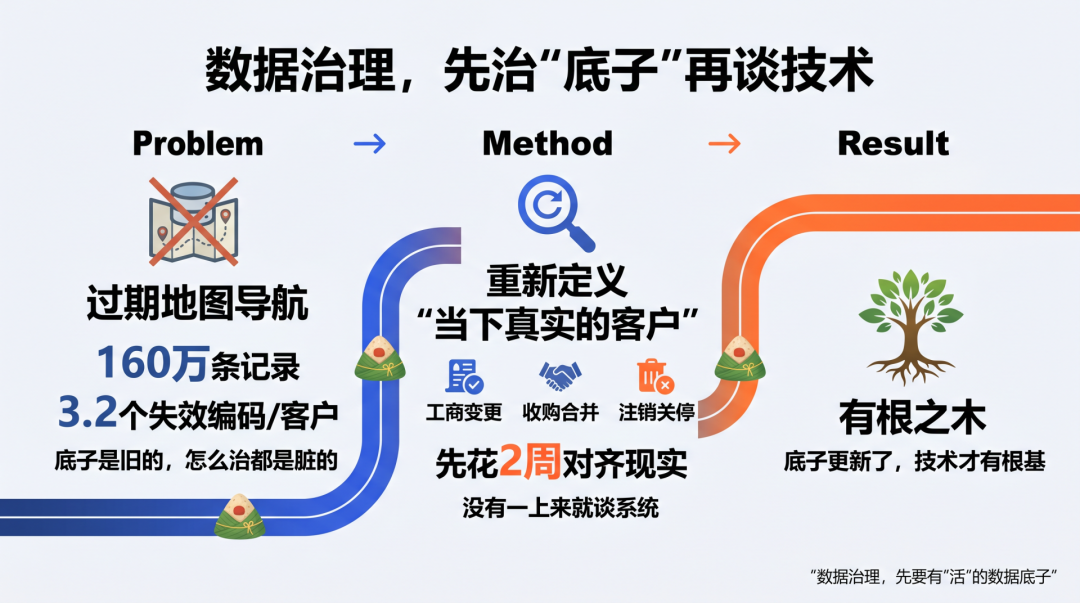
He opened the laptop he had brought and showed them a case: a pharmaceutical company's industry master database held 1.2 million records. After one update, they discovered 13.2 old codes that were already invalid. These redundant records were not "typing errors"; the database was too old to keep up with changes in the real world. Over three months, the team rewrapped these "zongzi that had fallen apart":
"We didn't start by talking about systems," Li said. "We first spent two weeks redefining what counts as 'a real customer today.' Changes in business registration, acquisitions and mergers, deregistrations and closures—we aligned each record with reality, one by one. Once that foundation was updated, the technology that followed finally had roots."
Lin Wei suddenly remembered Grandma's words: keep the wrapper tight.
The industry master database was the wrapper of that zongzi. If the wrapper was not tight—if the old database was full of old information—even the best filling added later would leak out.
After resolving the standards issue, Lin Wei hit a second hurdle.
The database had been updated, but the historical data could not fill all the fields required by the new standards.
She remembered a time when the sales director had come to her with a distribution flow analysis report: "This report says East China grew 15% last month. But I asked the regional manager to check, and actual growth was only 8%. Where did this data come from?"
When she investigated, every problem led back to "holes" left by the old database:
The new standards required product batch numbers and manufacturing dates, but those fields had never been collected under the old database, leaving them blank across thousands of historical records. The old database's format definitions were still the version from three years earlier: quantity fields accepted text and date fields accepted Chinese characters, completely incompatible with the new system's validation rules. Worse, the old database's benchmarks were long out of date. One distributor's "reasonable inventory reference value" was based on its shipment volume three years earlier. Its business had expanded fivefold in those three years, but when the system saw a single day's sales exceed its "theoretical monthly inventory," it immediately flagged the figures red and sounded an alert. The data was not wrong; the measuring stick was too old.
"It's like a zongzi with filling that isn't packed firmly," she complained to Li. "It looks like a zongzi, but you bite into it and it's hollow. There's nothing there."
After listening, Li told her a story.
He had previously worked with a pharmaceutical company whose old database contained a huge amount of data, but of very poor quality. They had put a great deal of effort into "data cleansing," yet the results never improved much.
"Later we realized the problem wasn't the 'cleansing,' but the 'source,'" Li said. "It's like wrapping zongzi: if the vat you soak the rice in is dirty to begin with, there will still be grit no matter how often you wash the rice. The old database was that vat. Its field standards, validation rules, and benchmarks were all relics of the past. Apply outdated rules to a new business, and nothing will fit properly."
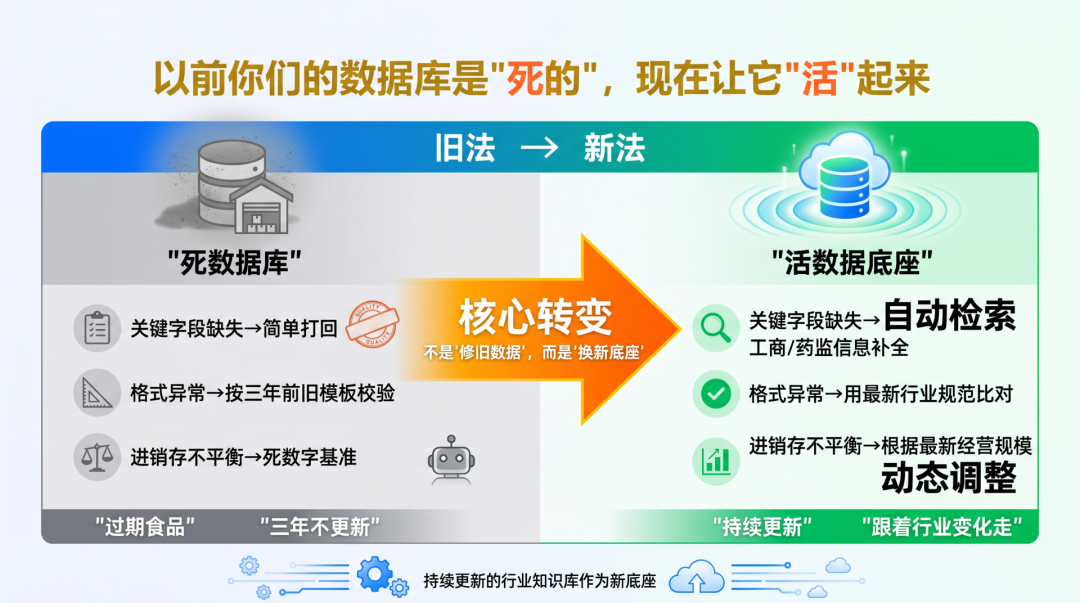
He demonstrated a solution. The core idea was not to "repair old data," but to use a continuously updated industry knowledge base as a new foundation. From the moment a distributor sent its data, the system performed "quality checks" against the latest standards. Missing key fields? Instead of simply rejecting the data, it automatically searched public information from business registration authorities, drug regulators, and other sources, attempting to fill the gaps. Unusual formats? Instead of validating against a three-year-old template, it compared them with the latest industry specifications.
Purchases, sales, and inventory out of balance? The benchmark was no longer a fixed number hard-coded into the database for three years, but one adjusted dynamically to the company's latest operating scale.
"Your database used to be 'dead,'" Li said. "With no updates for three years, all the information inside was like expired food. Now we're bringing it 'to life,' so it moves with the industry."
One detail particularly impressed Lin Wei: the system could recognize "alternative names and variant names." For example, the old database's product dictionary contained only "Madinglin" and treated "Madingling" as a different product. The updated knowledge base, however, knew that both names referred to the same thing.
"How did you do that?"
Li smiled. "Update the recipe, and you naturally know which ingredients belong together."
The final challenge was the data pipeline.
Lin Wei's pharmaceutical company had 1,350 distributor customers. More troublesome still, the data collection interfaces for those 1,350 customers had been deployed to the standards of the old database era, with outdated protocol versions, old field definitions, and rudimentary integration methods. Some used direct DDI connections, but their protocol versions had long stopped receiving updates. Some used FTP, but their file format definitions still followed a three-year-old template. Some emailed Excel files, while others required someone to download data manually from a web page. Because the old database had no standardized interface specifications at all, each connection had been improvised in its own way.
"It's as if the old recipe says 'wrap in lotus leaves,' but today's zongzi leaves are bamboo leaves. Follow the old recipe, and no matter how you wrap it, something feels wrong," she complained to Li.
Most alarming of all, the integration protocols from the old database era had no concept of "pipeline monitoring." Had the data been sent? Were any packets lost in transit? Had anything been missed during cleansing? Nobody knew.
"The pipeline is a black box," she said. "We only discover problems when we reconcile the accounts at month-end. By then, it's far too late."
Li was quiet for a moment after listening.
"I've seen situations like yours many times," he said. "The foundations of most companies' data governance are too old. An old database dictates old standards; old standards dictate old pipelines; and old pipelines mean—you have no idea at which stage your data went wrong."
"Then what should we do?"
"Update the foundation and rebuild the pipeline," Li said. "It's like wrapping zongzi. If you're using last year's dried leaves, they crack as soon as you fold them. However well you wrap them afterward, they'll still leak. Replace the foundation first, then tie the string again."
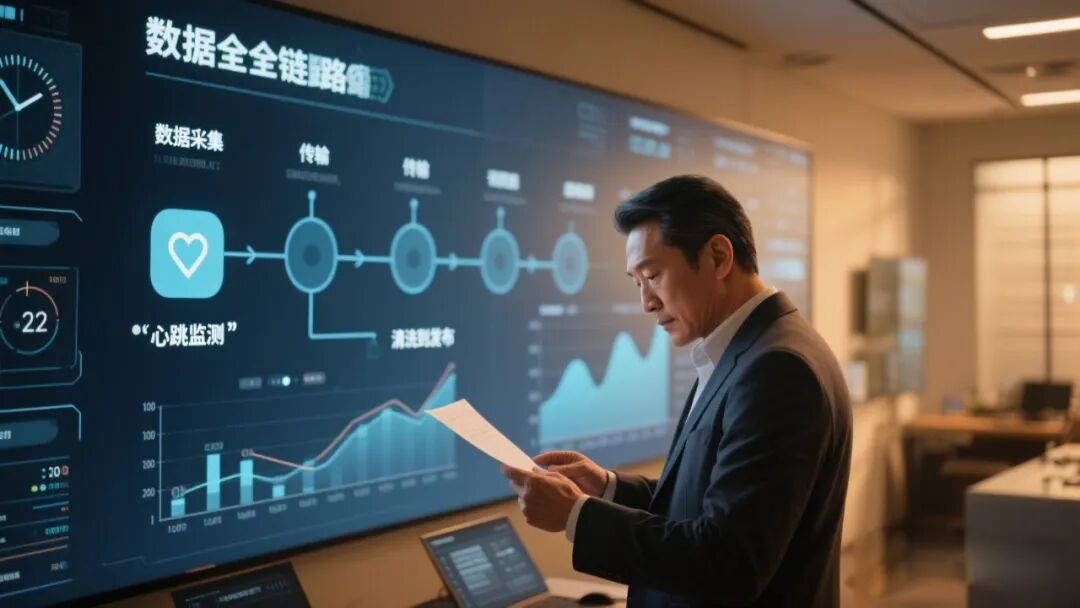
He drew a diagram for Lin Wei: an end-to-end pipeline redesigned around the latest industry knowledge base. From collection and transmission to cleansing and publication, every stage had "heartbeat monitoring":
A distributor's client connection drops? An alert within minutes.
A day's data has not arrived? Flagged red in real time.
An anomaly appears during cleansing? Automatically pinpointed to the specific stage.
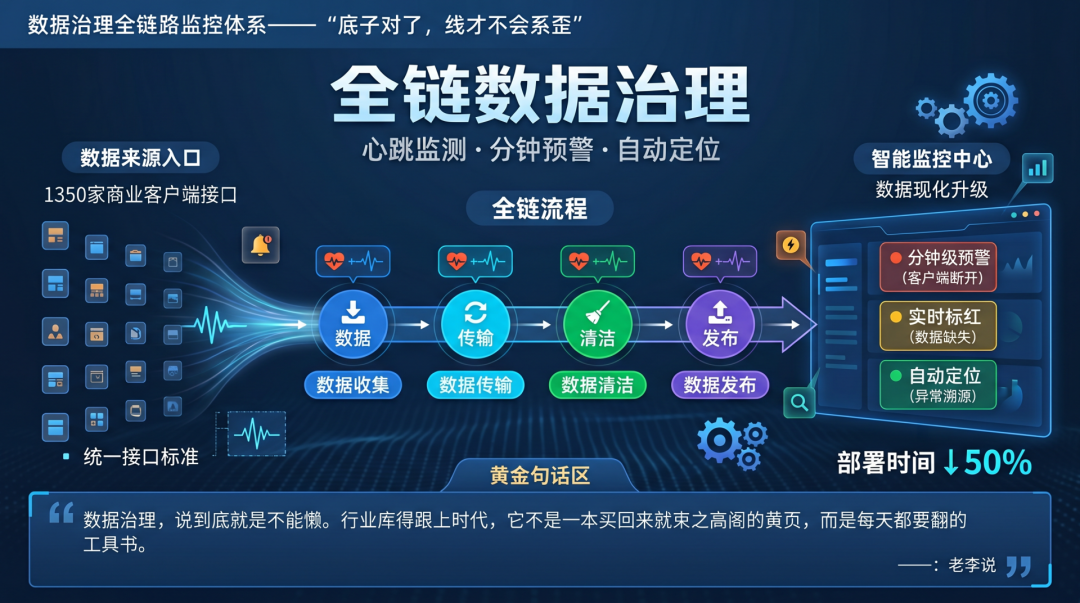
"Your old pipeline was built on the foundations of the old database," Li said. "Those foundations were full of cracks. Any building you put on them would wobble. Now that the foundations are updated, every link in the pipeline has a reliable reference point."
On the day of the switchover, the new industry knowledge base standardized the interfaces for all 1,350 customers, with deployment taking only half as long as before. Previously, each customer needed a separate "patch" to adapt to its old protocol. Now, everyone could simply follow the new standards.
"Get the foundation right, and the string won't end up tied in the wrong place," she said.
Li nodded. "Ultimately, data governance is about not cutting corners. An industry database has to keep pace with the times. It's not a copy of the Yellow Pages that you buy and leave gathering dust on a high shelf. It's a reference book you need to open every day."
Dragon Boat Festival
This Dragon Boat Festival, Lin Wei left work on time.
When she got home, her mother was in the kitchen wrapping zongzi. She washed her hands and walked over. "Mom, let me try."
This time, she remembered Grandma's words: keep the wrapper tight, pack the filling firmly, and tie the string in the right place.
While the zongzi were cooking, she sent Li a WeChat message: "The zongzi are in the pot. They shouldn't fall apart this time."

Li replied with a smiling emoji. "Data governance is just like wrapping zongzi. Both take care, and neither lets you cut corners. Once the database is updated, the rest of the work gets easier."
She took a bite of the zongzi she had wrapped herself. The sticky rice was soft and chewy, and the meat filling savory and fragrant.
So this was how satisfying it felt to get things right.
This article is adapted from a real Weiming Penguin client service case. The data has been de-identified.
P.S. Li is a senior data governance expert at Weiming Penguin. The system that helped them solve their challenges is called StarPlex.
Lin Wei said she wanted to treat Li to zongzi. Li replied, "No need for zongzi. Keeping your data in order is the best thanks you could give us."
🐧 Weiming Penguin — Your AI-Driven Data Intelligence Partner
📧 contact@tenez.cn ☎️ 13717915751 🌐 www.tenez.cn