The Nationwide “World Cup” Standings for Dual-Channel Pharmacies
Article images may contain Chinese text.

1725 VS 1
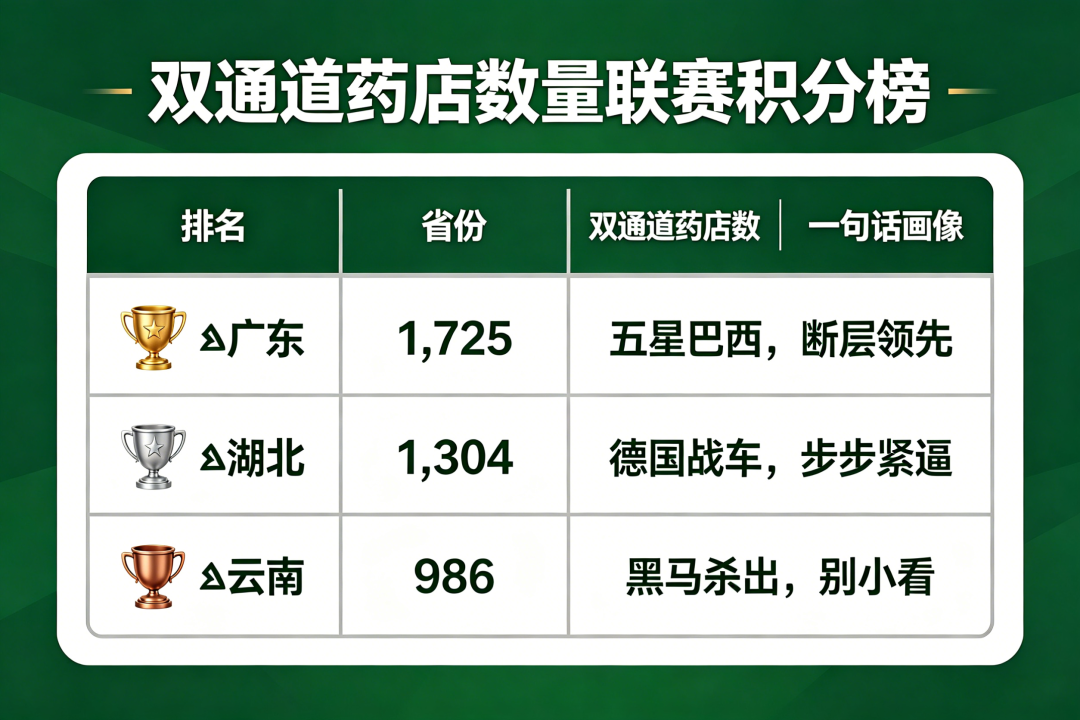
These two numbers are separated by a factor of 1725. The first is the number of dual-channel pharmacies in Guangdong Province. The second is the number in the Tibet Autonomous Region. If you ranked dual-channel pharmacy counts across 30 provinces in China in a “league table,” you would find that the storyline of this competition is surprisingly similar to the World Cup. The strongest stay strong, the gaps are enormous, and the powerhouses dominate.
“Dual-channel” means that medicines covered by China’s national price negotiations no longer have to be obtained only through hospitals—pharmacies can now sell them too, with coverage under China’s medical insurance system.
For patients: another way to obtain high-priced medicines covered by national price negotiations. For pharmaceutical companies: sales channels go from “single-core” to “dual-core.” For pharmacies: a whole new source of growth.
That covers the concept. Now, on to the main topic.
We compiled data from 30 provinces across China, excluding Hong Kong, Macao, and Taiwan. The nationwide total is 10,690 dual-channel pharmacies.
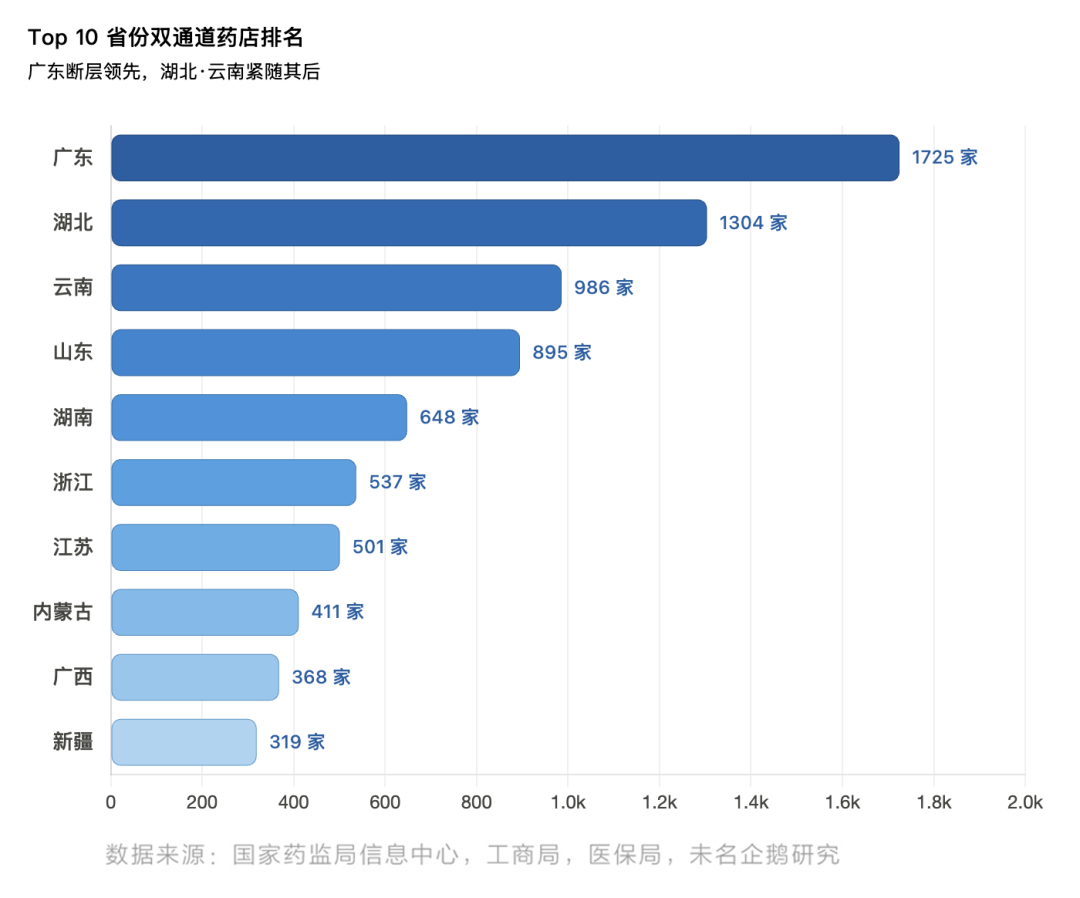
Ranked by pharmacy count, the top ten in the “league table” look like this:
The top ten account for 62% of the nationwide total. Outside the top ten? The gap widens more than you might imagine.
Now Look at the Bottom of the Table
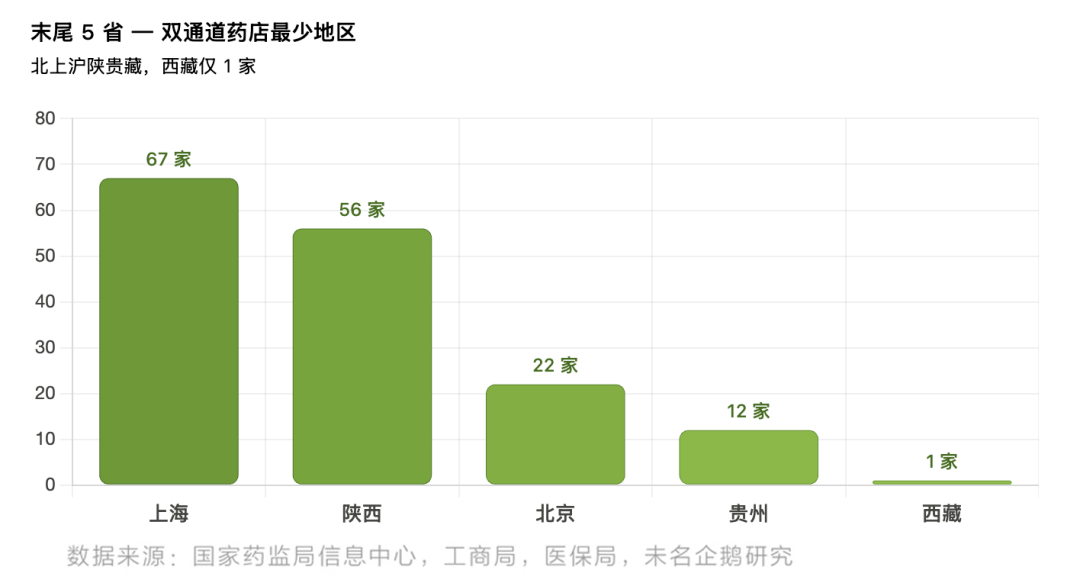
Yes, Tibet has just 1. It is a scene straight out of the World Cup—teams making their first appearance at the finals, standing on the field with a look that says, “Well, we made it this far.” But this is not a question of whether they are “good enough.”
Wait—22 in Beijing? 67 in Shanghai?
These two cities, with China’s strongest medical resources, are near the bottom in dual-channel pharmacy counts.
It is not because they are “not good enough.” Quite the opposite: they are too well equipped—with Grade III Class A hospitals clustered together, patients can obtain medicines covered by national price negotiations just a short walk away, naturally reducing demand for pharmacies as an alternative route “down the wing.”
Add relatively cautious policies in centrally administered municipalities, high urban store-opening costs, and their inherently smaller geographic size… Together, these factors produce this counterintuitive result.
The real conclusion is this: the number of dual-channel pharmacies does not directly equate to the quality of medical services. It reflects how much a region needs pharmacies to help ease the burden on hospitals.
The World Cup trophy almost always goes to traditional powerhouses.
The dual-channel market is also being divided among the same group of “powerhouses.”
Chains account for more than 80%. That is no coincidence. How high are the entry barriers for dual-channel pharmacies? Electronic prescription routing, cold-chain management, integration with medical insurance system interfaces—every step presents a technical barrier.
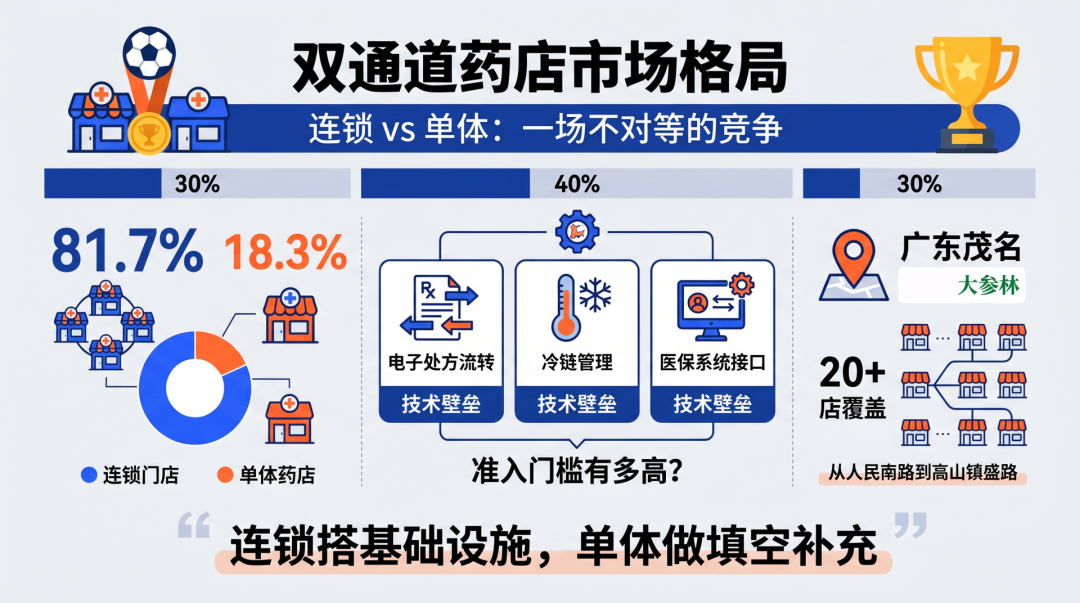
Independent pharmacies in the dual-channel field often have distinctive resources and strengths, making them a powerful complement to the chain network.
Take chain pharmacies in Maoming, Guangdong, for example: the single chain brand Dashenlin accounts for more than twenty dual-channel outlets, stretching from Renmin South Road to Gaoshan Zhensheng Road and covering the community grid of almost the entire city.
Chains do the heavy lifting, while independents provide complementary coverage—only together do these two lines form the complete dual-channel playing field.
In this round of data organization, we also completed standardized tag governance for dual-channel pharmacies.
Every pharmacy must be tagged with: industry database code, ownership classification (independent/chain), upstream company, brand name, and province/city/county.
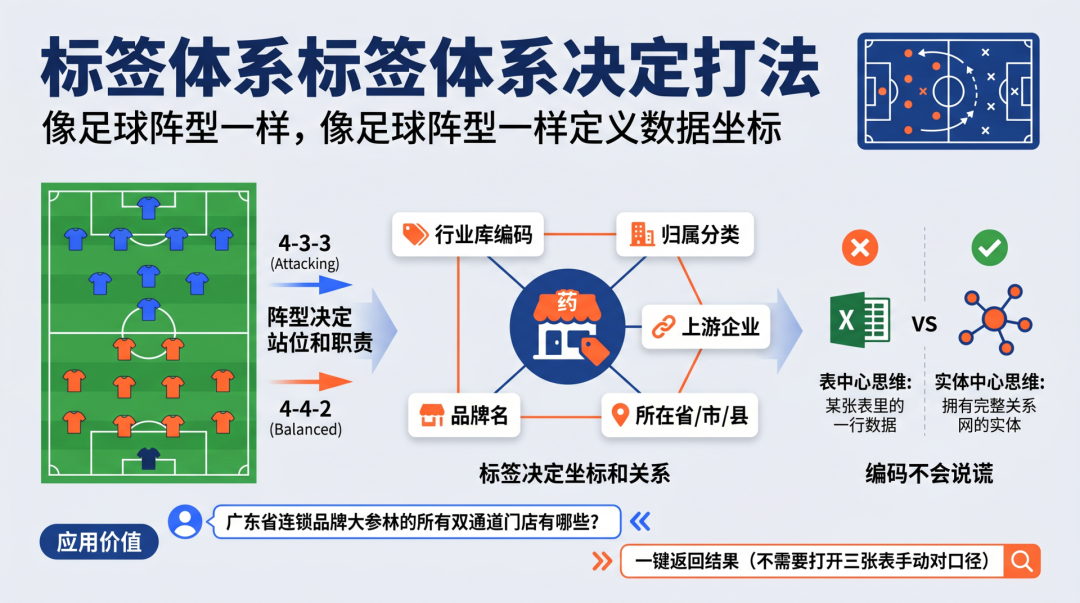
It is like a soccer formation—whether you play 4-3-3 or 4-4-2 determines each player’s position and responsibilities on the field. A dual-channel pharmacy’s tags determine its “coordinates” and “relationships” within the broader healthcare data network.
Pharmacy names may be duplicated, and outlets may relocate, but codes do not lie.
This is the philosophy we have always upheld: entity-centric thinking, not table-centric thinking. Treat each pharmacy as an entity with a complete relationship network, not as a row in an Excel spreadsheet.
With this foundation, you can quickly answer, “What are all the dual-channel outlets of the Dashenlin chain brand in Guangdong Province?”—without opening three tables and manually reconciling definitions.
Top teams never rely on a single attacking route. Break through on the left, cross from the right, shoot from distance in midfield—attacking along multiple routes is how you break down a defense.
The underlying logic of dual-channel access is exactly the same: hospitals + pharmacies, working on two fronts.
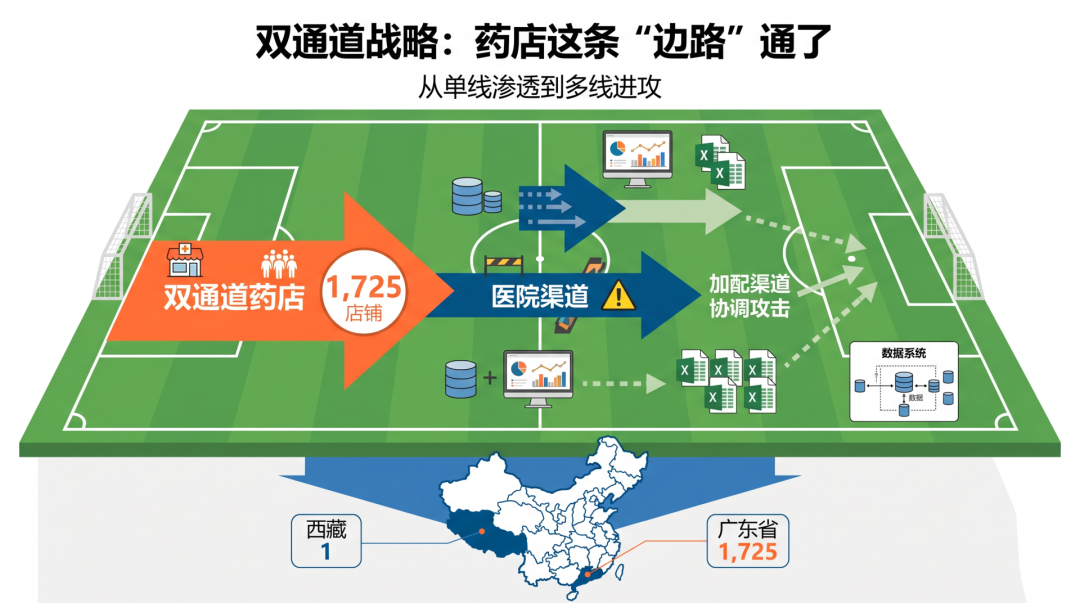
In the past, medicines covered by national price negotiations could only go through hospitals, like a team that only knows how to attack through the middle—easy to shut down. The dual-channel approach opens up pharmacies as a route “down the wing,” giving patients another point of access. But progress in building that route differs enormously across provinces:
Guangdong, 1,725 pharmacies: thriving on the wings, with patients able to buy medicines covered by national price negotiations at neighborhood pharmacies and obtain reimbursement through China’s medical insurance system Tibet, 1 pharmacy: the wing is open in theory, but cannot really get going in practice
For pharmaceutical companies, dual-channel access is not a matter of “opening a few stores and calling it done”—it is a systematic channel management undertaking: in which provinces are your products included in dual-channel lists? How many local pharmacies provide coverage? Are these pharmacies chains or independents? In which cities, districts, and counties are they located?
These questions require a data system that manages pharmacies as entities, not endless reconciliation across three Excel spreadsheets.

Scan to Contact Weiming Penguin
&
Phone:13717915751 Email:contact@tenez.cn
About the Series
“Monday Data Coffee” is produced by Weiming Penguin. Every Monday at 7 a.m., a cup of “data coffee” is ready when you open WeChat. With 52 editions a year, this light, frequent briefing lets you keep your finger on the industry's pulse during your commute.
Core value: One cup a week to refresh your mind, using high-value data to spark deeper thinking about the industry.
Sources: Information Center of China's National Medical Products Administration; administration for industry and commerce; healthcare security administration; Weiming Penguin Retail Outlet Dictionary. Corrections to any errors or omissions are welcome!
Disclaimer: This article is intended solely to share pharmaceutical information and does not constitute investment advice or recommendations for decision-making.