Article images may contain Chinese text.
In biopharmaceutical R&D, efficiently acquiring and using industry intelligence is key to staying competitive. As a leading biopharmaceutical company in China, Company A needs to track global academic developments, competing product progress, and market trends in real time throughout its R&D process. Traditional intelligence collection relies on manual searching and organization, which is time-consuming and leaves information fragmented, making it difficult to meet the need for rapid decisions.
To address this, Company A partnered with the Weiming Penguin team to adopt the most mature technical architecture currently used in AIGC—RAG+LLM. Combining private-domain intelligence with large-model capabilities, they built a dedicated [Intelligence Center] platform for intelligent management and use of intelligence.
Technical Architecture: Building an Intelligent Foundation with RAG+LLM The project uses a “RAG+LLM” technical framework, tightly coupling a private-domain intelligence database with large-model capabilities to create an end-to-end closed loop spanning “collection–processing–analysis–application.”
RAG (Retrieval-Augmented Generation)Vectorization technology converts vast amounts of unstructured data, such as literature and patents, into a searchable knowledge base to ensure precise information retrieval.
LLM (Large Language Model)An industry model custom-trained for the company enables advanced functions such as intelligence summary generation, multi-turn Q&A, and report writing, improving the efficiency of turning information into usable output.
This architecture preserves the rigor of specialist data while giving AI flexible natural language processing capabilities, laying the groundwork for subsequent scenario-specific applications.
Core Functions: Intelligent Upgrades Across the Entire Process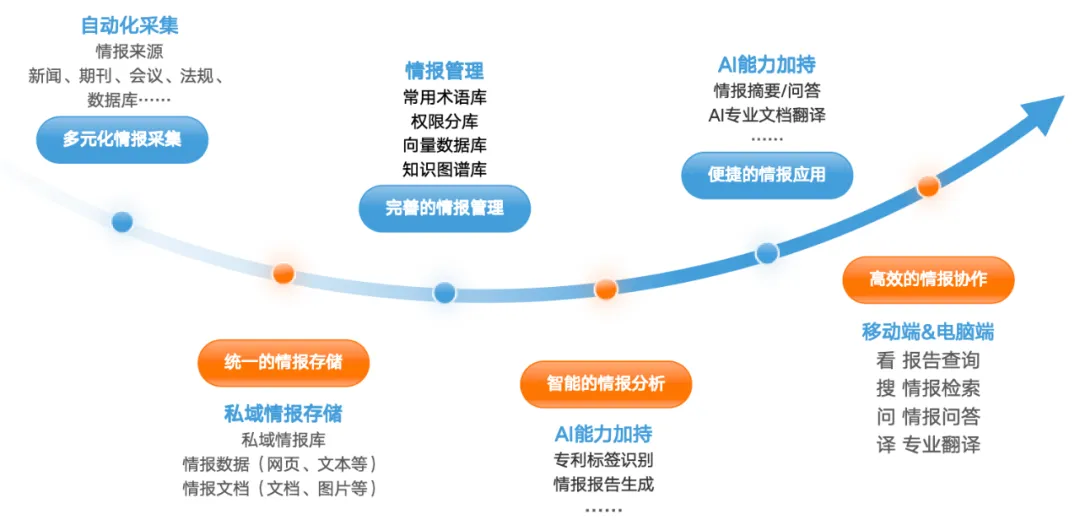 Diversification and automation are achieved. Intelligence from multiple channels, including news, journals, and conferences, is brought together through automated RPA collection, automated interface integration, and other methods, breaking down information barriers. The collected intelligence is stored in a private-domain intelligence database, encompassing intelligence data and intelligence documents to ensure data security and standardization.A comprehensive intelligence management repository is established, including a common terminology database and an access-permission assignment database. Intelligence is also preprocessed through steps such as content recognition and vectorization, with an ES search engine enabling efficient catalog searches. AI capabilities come into their own. The system supports intelligence summaries and Q&A, accurately summarizing both individual publications and broader questions. Patent tag recognition helps users identify core technologies. It can also automatically generate intelligence reports to improve work efficiency, while AI translation of specialist documents supports multilingual communication. Convenient intelligence applications are available on both mobile devices and computers, covering report viewing, intelligence searches, intelligence Q&A, specialist translation, and more, allowing researchers to access information anytime, anywhere.In an age of information overload, AI-powered intelligence tools have become a necessity for R&D companies. In this new era of pharmaceutical R&D, where “data is an asset,” Company A’s implementation has not only delivered a qualitative leap in internal efficiency but also explored an innovative path toward the deep integration of “technology–business–ecosystem.” It provides a reusable benchmark case for the industry and demonstrates the boundless potential of “data-driven R&D.”


