Penguin Geeks | A Brief Introduction to the Principles Behind DeepSeek-R1
Article images may contain Chinese text.
1. Deep Thinking: The Gateway to AI Reasoning
1. Deep Thinking: The Gateway to AI Reasoning
In recent years, large language models (LLMs) have demonstrated extraordinary capabilities through pretraining on vast amounts of data. Yet as models continue to grow, the human-generated corpora used to train them are gradually approaching their limits. Remarks made six months ago by former OpenAI Chief Scientist Ilya Sutskever proclaimed the end of the pretraining era, suggesting that the traditional approach of improving model capabilities simply by increasing parameter counts is gradually losing ground.
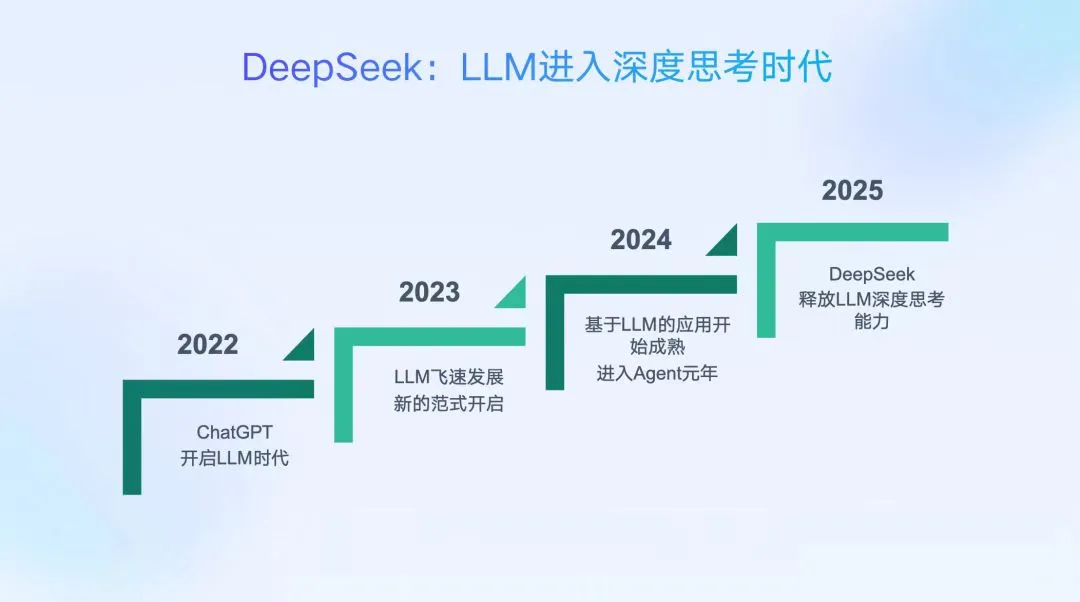
In Thinking, Fast and Slow, psychologist Daniel Kahneman divides human thinking into two modes: [System 1], which represents unconscious, fast thinking, and [System 2], which represents rational, slow thinking. LLMs operate more like fast thinking, rapidly retrieving information from vast stores of knowledge, but complex problems call for the deeper thinking of [System 2]. From reports of OpenAI's mysterious Q-star project to the subsequent launch of o1, the world's first large model for deep reasoning, these developments marked AI's entry into an era of 'slow thinking.' Rather than relying on immediate responses, models solve problems through multistep reasoning, much as humans do. Amid this transformation, DeepSeek-R1 burst onto the scene, not only challenging technological monopolies through its open-source approach but also demonstrating to the world another possibility for reasoning capabilities through 'pure reinforcement learning.'

2. Pure Reinforcement Learning: AI's 'Wilderness Survival' Adventure
When tackling the challenge of deep reasoning, traditional technical approaches still rely on supervised fine-tuning (SFT), which requires large amounts of manually annotated chain-of-thought data, also known as reasoning-process data. This is expensive and offers limited generalization. The DeepSeek team, however, chose a counterintuitive path: using reinforcement learning (RL) alone to elicit the model's autonomous reasoning capabilities. Without process supervision, training relies solely on feedback from the outcomes of policy evaluation. It is like a baby learning to walk through countless attempts and falls, without demonstrations or guidance from adults, relying only on its own feedback and adjustments. This is the training logic behind DeepSeek-R1-Zero.
Through rule-based reward signals such as answer accuracy and adherence to formatting requirements, the model continually optimizes its policy during RL and independently generates long sequences of reasoning steps. Interestingly, although the reward rules do not explicitly encourage 'self-verification,' reflective behavior emerges spontaneously in the model, including human-like 'aha' moments. These remarkable results have inspired curiosity and further exploration. In replication tests, some research institutions found that self-reflective patterns were already present at the initial stage of RL—that is, in the base model, DeepSeek-V3-Base—and called this superficial self-reflection (SSR). Although self-reflection in this setting does not necessarily lead to a correct final answer, the long-form reasoning capability that the model gradually learns stems from carefully designed RL optimization. By maximizing the overall reward, the model naturally develops efficient and robust behavioral policies.
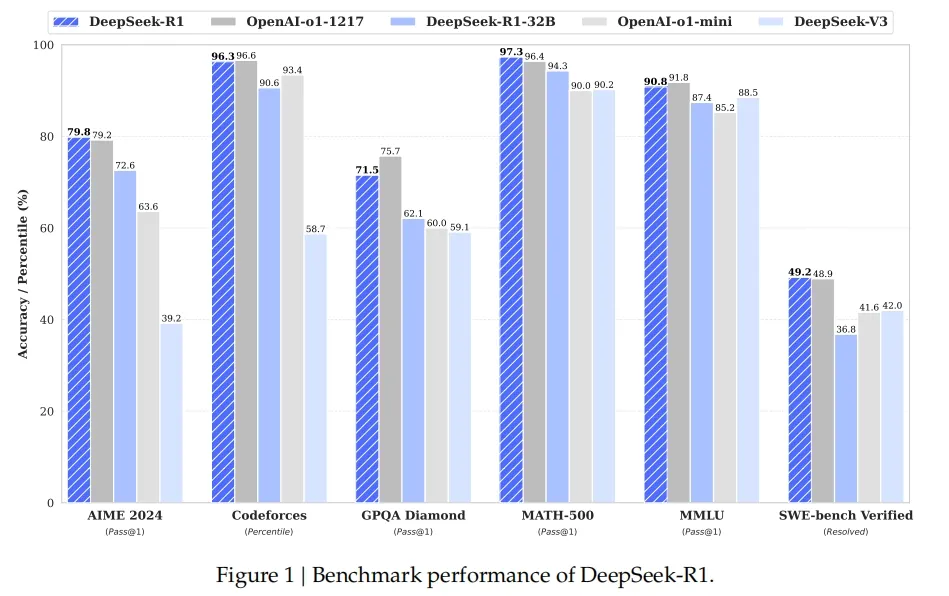
This ability to 'learn without a teacher' also comes at a cost: the model can become trapped in repetitive loops, generate lengthy, unintelligible content, and even mix Chinese, English, and other languages in its output. To address these issues, DeepSeek-R1 introduces multistage training. It first uses a small amount of cold-start data for SFT to guide the model's basic reasoning capabilities, then optimizes deep reasoning through reinforcement learning. During the convergence stage, rejection sampling is used to select high-quality data, after which multitask data is used to integrate general capabilities. Finally, RL across all scenarios aligns the model with human preferences, ultimately producing exceptional performance comparable to o1 on tasks such as mathematics and coding.
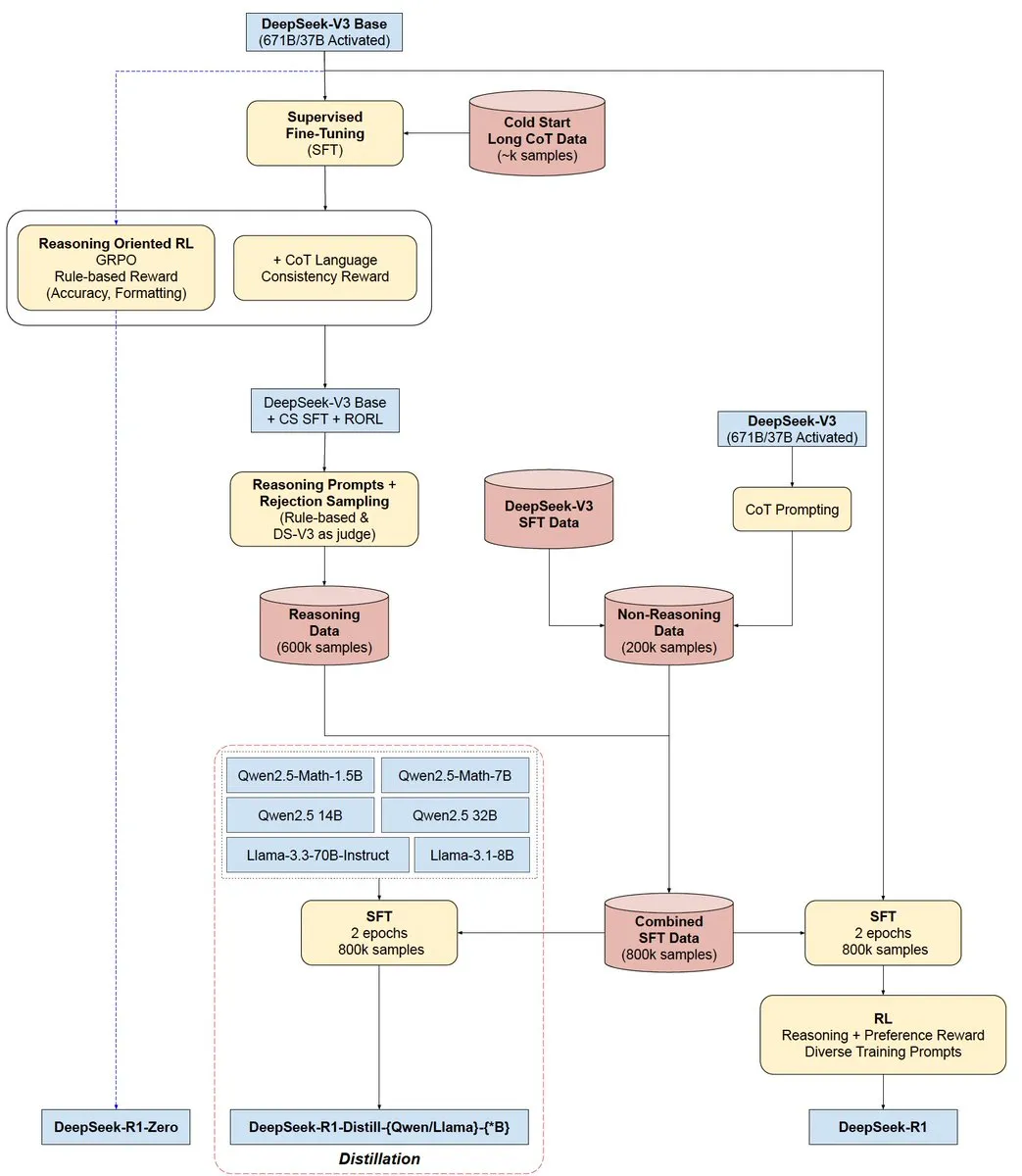
Chain of Thought in DeepSeek's Large Reasoning Model
3. Open Source and Transparency: Breaking AI Hegemony
DeepSeek-R1's dramatic arrival is significant not only for its disruptive technological innovation but also for its open attitude toward sharing through open source. From the model architecture and training code to the full weights of its 685 billion parameters, as well as six distilled models based on open-source foundation models such as LLaMA3 and Qwen2.5, the DeepSeek team has made every detail public. This candor and openness have earned widespread praise and an enthusiastic response from research institutions and developers on small and midsize teams around the world. DeepSeek-R1's improved mixture-of-experts (MoE) model increases the efficiency of load balancing across experts through a lossless auxiliary strategy. Its multi-token prediction (MTP) technology significantly increases decoding speed during inference, accelerating the breakdown of complex problems. Together with its low-level operator optimization capabilities, these advances demonstrate its deep technical expertise and outstanding capacity for innovation.

No wonder people online call DeepSeek the truly 'open AI'!
4. Lessons and Outlook: The Boundless Possibilities of AI's Future
DeepSeek-R1's practical results reveal an important conclusion: reinforcement learning can not only optimize answers but also elicit a model's 'metacognition.' When reward mechanisms are designed appropriately, AI spontaneously explores more efficient reasoning strategies, and this emergent behavior extends far beyond the boundaries humans have predefined. However, the pure RL approach places extremely high demands on computing power and data quality, while the unpredictability of model behavior remains a potential risk.
In the future, as more teams join this exploration, the convergence of 'reinforcement learning + reasoning' may give rise to a new generation of artificial general intelligence. Perhaps DeepSeek-R1's significance is much like the image evoked by its name: a whale-like spirit finding its way through the deep sea, lighting a beacon that guides the industry toward the unknown.